GMR UK: Create, Check and Use a Goods Movement Reference

A Goods Movement Reference (GMR) is the central reference for one vehicle, trailer, or container movement through a route using the UK Goods Vehicle Movement Service (GVMS). The haulier creates it before check-in, links the required customs or transit references, and presents the GMR to the carrier. Before and during the crossing, the haulier must also check whether the GMR is valid or whether HMRC has issued inspection instructions.
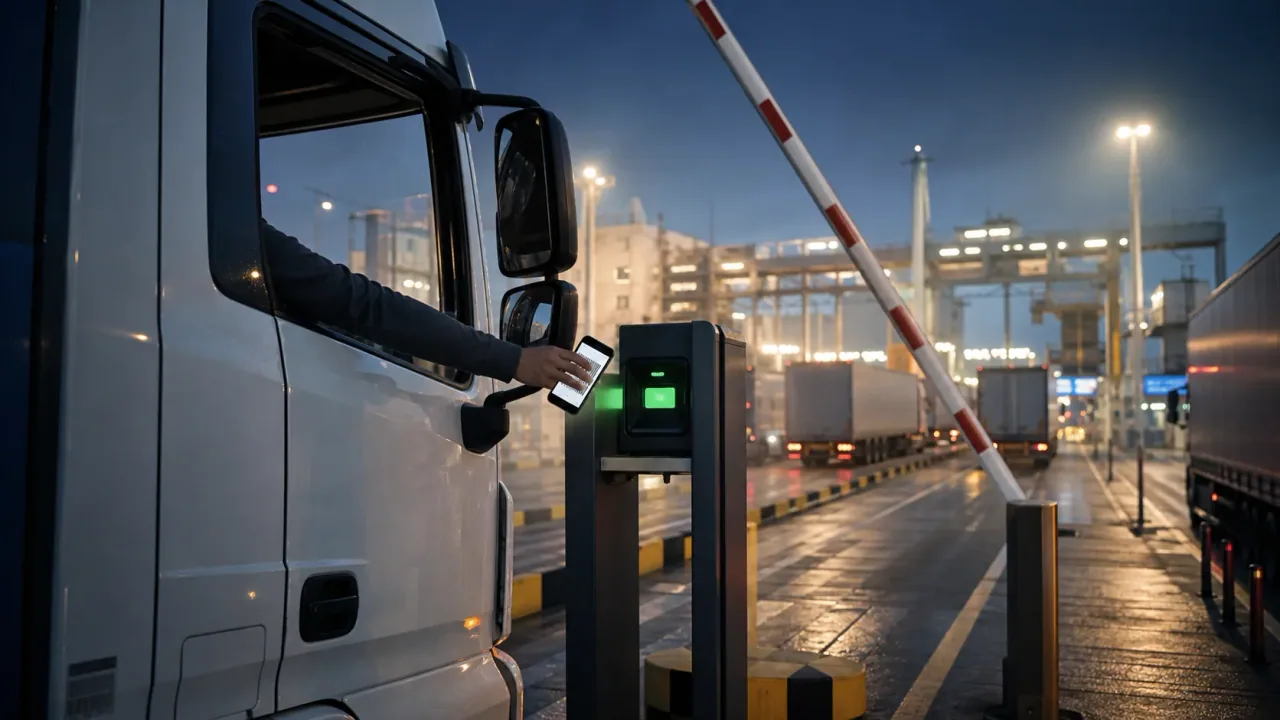
Tuesday, 4:15 a.m. at the Eurotunnel terminal in Calais. The headlights of waiting trucks cut through the fog as a driver reaches out of the window with a smartphone. On the screen: a barcode, the Goods Movement Reference (GMR). A short beep, the barrier opens, and the truck rolls onto the train. No thick folders, no long wait at a customs counter.
Anyone moving goods across the border between the EU and Great Britain is operating inside a fully digitized customs infrastructure. At the center of that system is the Goods Vehicle Movement Service (GVMS) run by HMRC, the UK tax and customs authority. What looks like a simple ticket is actually a bundle of highly complex data flows in the background.
What is a GMR and when do you need one?
GVMS is a real-time digital system used by the UK government to control goods flows at RoRo ports. RoRo means roll-on/roll-off, including ferries and the Eurotunnel. Because these hubs do not have enough physical space for long customs checks, the customs process has to happen before the truck even boards the ferry or train.
The GMR (Goods Movement Reference) is the digital manifest for one specific journey. Instead of a port operator or customs authority checking ten separate customs declarations for one truckload, the GMR combines all relevant procedures, including import, export, and transit, into one scannable reference number.
It is required when goods move through a route or border location using GVMS. These include movements through Dover and the Eurotunnel. Certain empty movements also require a GMR. The exact route and movement requirements should be checked against current HMRC guidance and with the carrier before departure. A vehicle cannot board on a GVMS route without a GMR that is ready for check-in.
How to create a GMR in four steps
The process requires exact coordination between exporter, customs agent, and haulier. Because a GMR is directly linked to the planned crossing, it is usually created by the transport company or the appointed freight forwarder.
- Prepare the customs declarations: Before the GMR is finalized, the required declarations must exist in the UK Customs Declaration Service or the transit movement must exist in NCTS. These systems provide the necessary MRNs and other references.
- Log in to the GVMS portal: The person creating the movement signs in with the details associated with the operator's GVMS registration. The required EORI number and permissions depend on the role and movement type.
- Enter journey data: The direction of travel, departure port, ferry operator, vehicle registration, and trailer number are added.
- Link the required references: The customs or transit references required for that movement type are added to the GMR. The system validates the information electronically. If everything is correct, the GMR and its barcode are generated.
A practical detail matters here: every vehicle movement through a GVMS route needs its own GMR. For groupage, the haulier bundles the required references for the consignments inside the vehicle. Common Transit Convention movements have specific linking rules; HMRC notes, for example, that associated import declaration references should not also be added alongside the transit MRN.
The physical border becomes easier to cross because the digital border has already been cleared miles in advance.
How to check whether a GMR is valid or held
Creating a reference does not automatically mean it is ready for the crossing. Before check-in, the haulier should confirm that the GMR is complete and valid. In an API integration, a usable GMR is normally in the OPEN state. An incomplete or invalid record may be returned as NOT_FINALISABLE and must be corrected.
- The physical scan: At check-in at the ferry terminal or Eurotunnel, the carrier, such as Eurotunnel, P&O, or DFDS, scans the GMR barcode.
- The digital gate: The ferry operator's system checks the GMR against the HMRC database. If the required information and references are valid, the vehicle can check in. If there is an error, the GMR must be corrected before departure.
- The automatic trigger at sea: While the truck crosses the Channel, the algorithm keeps working. Once the ferry or train has departed, the carrier reports that departure to GVMS. The system automatically sets the linked customs declarations at UK customs to arrived status.
- The arrival decision: The driver or haulier must check the current status and follow HMRC instructions. If an inspection is required, the vehicle must proceed directly to the specified inspection site or Inland Border Facility.

The tech twist: algorithms instead of spreadsheet chaos
Anyone still building GMRs manually by copying and pasting data into government web forms risks expensive waiting times. One typo in a single MRN from a groupage truck with 20 consignments can block the entire vehicle at the ramp in Calais.
Modern customs and logistics processes solve this through automated API integrations. Intelligent software pulls customs data directly from the customer's ERP system or customs software, matches it with vehicle data from dispatch planning, and generates the GMR automatically in the background. The driver receives the correct barcode directly on the telematics display in the cab.
Conclusion: the border becomes a data flow
GVMS shows clearly where international customs is heading: away from paper-based checks at the line and toward data-driven pre-validation in the background. The physical border becomes easier to cross because the digital border has already been cleared miles in advance.
Do you want to accelerate your UK supply chains and eliminate the risk of errors in GMR processes? Contact our experts to learn how GVMS and CDS processes can be integrated seamlessly and fully automatically into your system landscape.
More articles

ICS2 and ENS at the EU border
Why freight needs clean pre-arrival data
March 29, 20264 min read
NCTS basics
Why transit powers global trade
February 7, 20264 min read
Incoterms and customs
EXW, FCA, DAP, and DDP through the lens of customs, tax, and process design
June 2, 20265 min read