What Is an EAD? Export Declaration, MRN & Proof of Exit


An export generates several terms, references, and documents that are easy to confuse in day-to-day operations: the export declaration, export accompanying document, MRN, and proof of exit.
They belong to the same procedure, but they perform different jobs. The export declaration starts the customs process. After release, the movement receives an MRN and, in most standard cases, an Export Accompanying Document. Only after the goods have left the customs territory of the European Union does the exit confirmation document the physical exit.
That distinction matters to shipping, customs, and finance teams. Having an EAD does not automatically mean that the export has been completed or that the required tax evidence is available.
| Term | Meaning | When it appears | Purpose |
|---|---|---|---|
| Export declaration | Electronic customs declaration for export | Before the goods are released | Sends the required export data to customs |
| MRN | Master Reference Number | After acceptance or during the electronic procedure | Identifies the customs movement uniquely |
| EAD | Export Accompanying Document | Usually after release for export | Carries reference data for the next stages of the export |
| Proof of exit | Electronic confirmation of the goods' actual exit | After the goods leave the EU customs territory | Provides evidence that the export took place |
The export declaration starts the movement, the MRN identifies it, the EAD accompanies it, and the exit confirmation records its completion.
What is an export declaration?
The export declaration is the electronic notification through which the exporter or its representative tells customs which goods are intended to leave the customs territory of the European Union.
In Germany, the electronic process runs through ATLAS Export and AES. The declaration contains the information customs needs to assess, release, and supervise the movement.
Typical data includes:
- exporter, declarant, and representative
- EORI numbers for the relevant parties
- consignee and country of destination
- goods description and commodity code
- goods value and, where required, statistical value
- net and gross mass
- number and type of packages
- delivery terms
- mode of transport and intended customs office of exit
- licences, supporting documents, and other customs information
Vague goods descriptions, incorrect commodity codes, inconsistent weights, or missing licence references can lead to questions and delays. The quality of the declaration therefore has a direct effect on how smoothly the goods can be released.
When is an electronic export declaration required?
Goods leaving the EU are subject to customs declaration requirements. For commercial consignments, the familiar thresholds of more than EUR 1,000 in value or more than 1,000 kilograms in net mass are frequently relevant. Above those thresholds, an electronic export declaration is normally required.
Depending on the circumstances, simplified, oral, or deemed declarations may be available below the thresholds. The value and weight limits are not a universal exemption, however.
An electronic declaration may still be required below them when, for example:
- the goods are subject to prohibitions or restrictions,
- an export licence or another special document is required,
- excise rules apply,
- a special customs procedure is used, or
- other formalities under Union law must be observed.
Invoice value alone is therefore not enough to decide the correct process. The goods, their intended use, the destination, and the customs procedure also matter.
The EAD accompanies the export. Only the exit confirmation proves that the goods left the EU.
What is an Export Accompanying Document?
The Export Accompanying Document, commonly shortened to EAD, is generally produced in the electronic export procedure after customs releases the goods for export.
It is not the same thing as the export declaration. The declaration is the data submitted to customs; the EAD is the accompanying and reference document produced for the subsequent stages of the movement.
An EAD typically contains:
- the movement's MRN,
- a machine-readable barcode,
- references to the exporter and declarant,
- information about the goods items,
- weights and packages,
- the intended customs office of exit, and
- other information taken from the declaration.
Under the German ATLAS procedure, the MRN and its barcode must generally be available at the customs office of exit for a direct export. They may be presented using the EAD or another suitable representation.
The important distinction is that the EAD records the release of the goods for export. By itself, it does not prove that the goods actually left the European Union.

What is an MRN?
The MRN, or Master Reference Number, is the unique reference assigned to a customs movement.
It allows the declaration and the related electronic messages to be identified consistently in customs systems. MRNs are used in more than one customs procedure, so an MRN on its own does not reveal whether it belongs to an export, transit, or another movement.
Within the export process, the MRN links:
- the export declaration,
- the Export Accompanying Document,
- presentation at the customs office of exit,
- status messages and possible control results, and
- the eventual exit confirmation.
For shipping and customs teams, it is the central reference for questions, status checks, and document matching.
How does the export procedure work?
A typical electronic export can be divided into five stages.
1. Prepare the export data
Invoice, goods, consignee, packaging, and transport data are brought together. EORI numbers, commodity codes, licences, and potential export restrictions must also be checked. That includes a defined process for screening counterparties and transaction participants against sanctions lists.
2. Submit the export declaration
The data is sent to the competent customs office of export through ATLAS Export or AES. The company can submit it itself or appoint a customs representative.
3. Present and release the goods
Customs assesses the declaration and may request documents or inspect the goods. Once the checks are complete, the goods are released for export. The movement receives its MRN and, in standard cases, the EAD is made available.
4. Present the goods at the customs office of exit
The goods are identified at the actual customs office of exit. This may be at a seaport, airport, or another office on the EU external border.
The customs office of exit supervises the goods' departure from the Union customs territory and sends the corresponding exit result to the customs office of export.
5. Receive and archive the exit confirmation
Once the physical exit has been confirmed electronically, the customs office of export makes the proof of exit available. The record should be matched unambiguously to the underlying transaction and invoice, then retained in line with the relevant tax and commercial-record requirements.
Why does proof of exit matter?
The exit confirmation records that the declared goods have left the customs territory of the European Union.
That makes it fundamentally different from the EAD:
- The EAD records the release of the goods for export.
- The proof of exit records the goods' actual departure.
For electronic exports from Germany, the official exit confirmation is normally the central document used as evidence for German VAT purposes. The relevant requirements are set out in sections 9 and 10 of the German VAT Implementation Regulation.
The proof of exit is not a physical customs stamp placed on the EAD. It is an electronic message or electronically supplied document.
What happens when proof of exit is missing?
If customs has not received the exit result 90 days after release, the customs office of export generally starts a follow-up procedure. The declarant or representative is asked to clarify what happened to the goods.
Common reasons for a missing exit confirmation include:
- the MRN was not captured correctly at the customs office of exit,
- the goods used a different office of exit than the one declared,
- an exit message was not transmitted correctly,
- the goods have not yet left the EU,
- the planned export did not take place, or
- the export and transit movements were not coordinated correctly.
Depending on the case, alternative evidence can be submitted for assessment by customs. It may include transport documents, import evidence from the destination country, or confirmation from a carrier.
When customs accepts alternative evidence, it may issue an alternative proof of exit. German VAT rules also provide for other forms of evidence in defined circumstances when the standard electronic confirmation cannot reasonably be produced.
It is therefore too broad to say that a missing standard exit confirmation automatically removes the VAT exemption. The operational risk is still substantial: without clear and readily verifiable export evidence, the business may struggle to support the VAT treatment during a later audit.
How are export and NCTS connected?
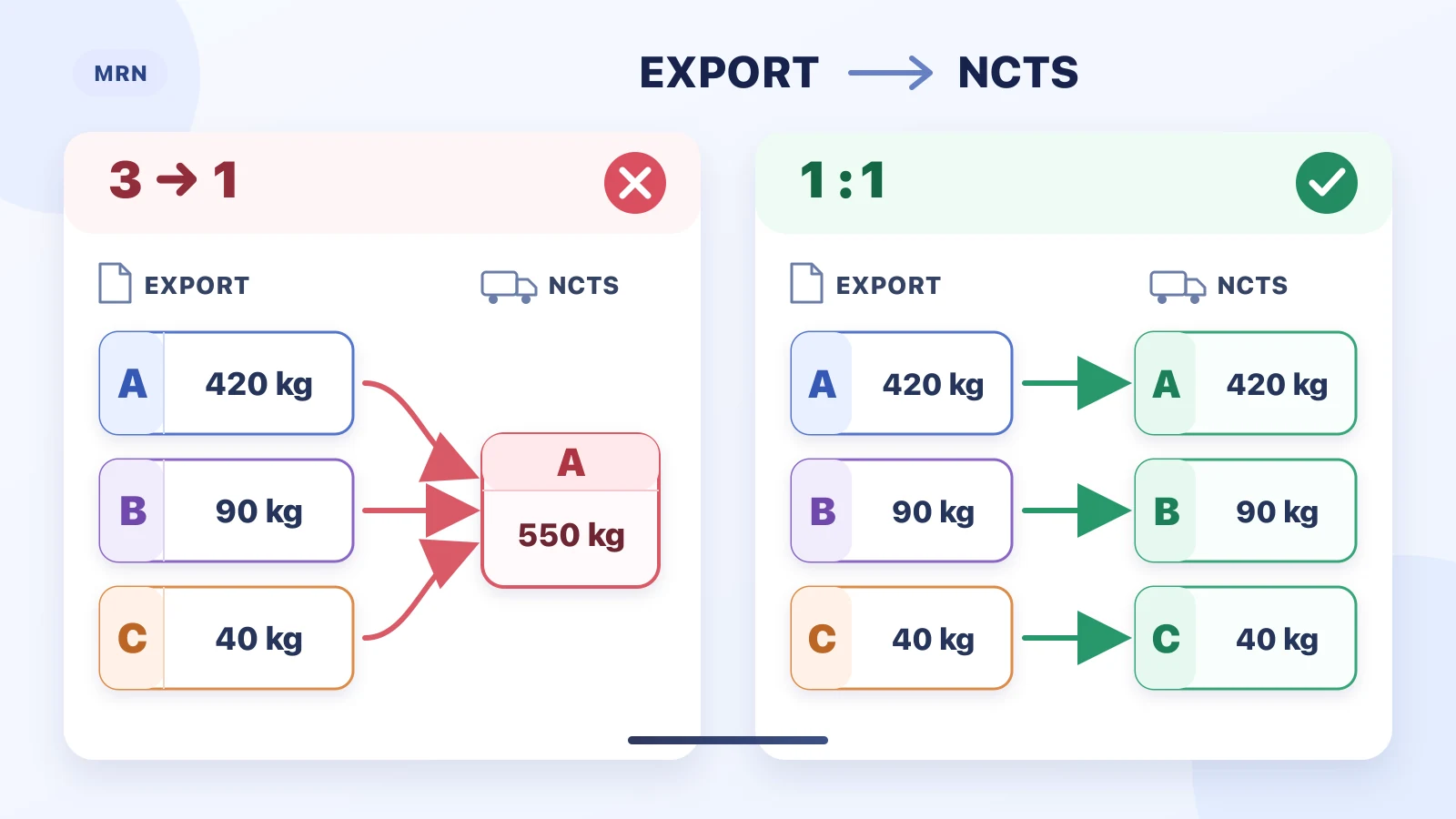
An NCTS transit procedure may follow an export when goods continue under customs supervision after being released for export.
In that situation, the export and transit movements have to be coordinated correctly. The customs office of departure for the transit movement may perform the tasks of the customs office of exit, while status messages between the relevant ATLAS procedure areas support completion of the export.
The export MRN and transit MRN remain separate references. They should not be confused in either customs processing or document matching.
For a detailed explanation of T1, T2, and NCTS, read our guide to the NCTS transit procedure.
Which errors cause the most problems?
Many delays begin during preparation rather than at the border.
Typical sources of error include:
- vague or contradictory goods descriptions,
- incorrect commodity codes,
- inconsistent weight or package data,
- incorrect or missing EORI numbers,
- unclear roles for exporter, declarant, and representative,
- an unsuitable customs office of exit,
- missing licences or document references,
- invoice and transport data that do not match,
- missing links between export and transit movements, and
- no reliable match between the proof of exit and the sales invoice.
The final point often becomes visible only during month-end work or a tax audit. An exit confirmation has limited value if the company cannot assign it reliably to the correct transaction.
How can open export movements be controlled more effectively?
Manual checks may be sufficient for occasional exports. As volume grows, however, coordinating MRNs, exit confirmations, and follow-up cases across email, spreadsheets, and separate archives becomes increasingly difficult.
A structured digital workflow can:
- receive invoice and shipment data from source systems,
- identify missing or contradictory information before submission,
- match the MRN and EAD to the correct order,
- process status messages from the customs procedure,
- flag missing exit confirmations early, and
- archive documents with the related invoice or shipment.
Automation does not replace customs expertise or the assessment of sensitive goods, destinations, and licence requirements. Its main value is reducing transcription errors and making unresolved movements visible sooner.
Learn more about ATLAS customs software and preparing an export declaration from invoice and PDF data.
Checklist: Is the export movement complete?
Before closing an export internally, the company should be able to answer at least the following questions:
- Was the export declaration accepted?
- Were the goods released for export?
- Are the MRN and EAD matched to the correct order?
- Were the goods presented at the actual customs office of exit?
- Is the electronic exit result available?
- Is the proof of exit matched to the correct invoice?
- Have discrepancies and follow-up actions been documented?
- Are the records being retained in a traceable and timely manner?
Conclusion: The EAD is not the end of the export
The Export Accompanying Document is an important part of the export procedure, but it is not the final step. Only the exit confirmation records that the goods actually left the customs territory of the European Union.
Four elements therefore have to work together:
- a complete export declaration,
- the unique MRN,
- the Export Accompanying Document for the operational movement, and
- the proof of exit as evidence of the goods' departure.
Companies with recurring exports should not manage these elements in isolation. The decisive factor is a continuous audit trail from the order and customs declaration through to the final proof of exit.
If you want to validate export data digitally, receive MRNs and documents centrally, and monitor outstanding exit confirmations systematically, learn more about digital export declaration processing with Declarium.
Official sources
- European Commission: How the EU export procedure works
- German Customs: Procedures for exports to non-EU countries
- German Customs: ATLAS procedure instructions
- German VAT Implementation Regulation, particularly sections 8–10
This article provides a general overview and does not replace customs or tax advice for a specific export movement.
More articles
ATLAS data check 2026
When export and transit data do not match
August 17, 20268 min read

Sanctions list screening
Duties, match review and automation explained clearly
August 6, 20269 min read

NCTS basics
Why transit powers global trade
February 7, 20264 min read