Algorithms, not filing cabinets: our contribution to even Report #4

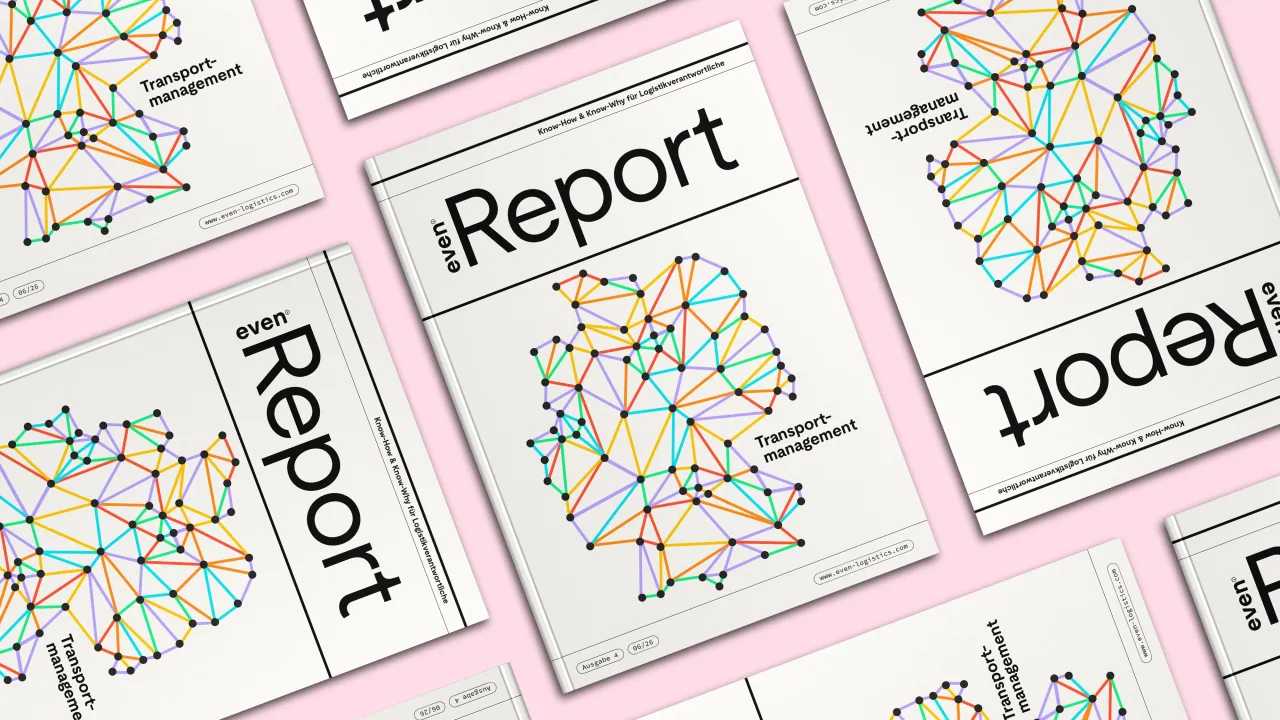
Transport management does not end at the loading dock. As soon as goods cross borders, the quality of customs data helps decide whether a transport actually runs smoothly or whether a well-planned process stalls at the last moment.
That is why we are pleased to be featured with Declarium in even Report #4 on transport management. Our contribution looks at customs not as a downstream obligation, but as part of a digital supply chain: integrated, data-driven, and increasingly supported by AI.
The following article is based on our contribution to the report. The full even report is published in German.
Why modern companies should treat customs as a strategic instrument
It is Tuesday, 7:37 a.m. A truck is standing in the shipping center, ready to leave for Switzerland. The goods are loaded, the route is planned, and the driver is waiting. But in the office, things are hectic. The customs broker is waiting for a corrected pro forma invoice because the customs tariff number does not match the physical product description and has also been invalid for two years.
Emails are flying back and forth, PDFs are being downloaded and sent, and the phone keeps ringing. It is a classic morning in the world of fragmented processes with many stakeholders; and at the same time, it is a symptom of a problem that reaches far beyond logistics.
In modern logistics, we optimize every centimeter of loading space, plan efficient transport routes, and monitor shipments in real time. But as soon as goods reach a customs border, we often fall back into a digital stone age. Historical processes are rarely questioned in terms of cost and speed. The motto is often: "Never change a running system."
While the physical flow of goods is automated, the associated data flow resembles an obstacle course across heterogeneous system landscapes, media breaks, and coordination loops. Most participants plan enough buffer in the form of time and cost to absorb these issues. That may create a feeling of safety, but it is anything but efficient.
The end of paper-based customs work
For a long time, customs clearance was treated as a necessary evil: an administrative task that companies preferred to park in a specialist department or blindly delegate externally, hoping they would never have to hear about it again. But with geopolitical shifts and "Trump 2.0", customs-related topics are receiving an entirely new level of attention.
Keeping customs topics isolated is becoming a risk and a tangible competitive disadvantage. If data is also manually exported from upstream systems, reformatted, and copied, an error is not a question of "if" but of "when". The waste is enormous. This is not only about time, but also about unnecessary cost and negative customer experiences.
Companies that meaningfully integrate their processes at working level are not looking at marginal improvements: cost potential above 50 percent and a halving of lead times are the logical result of a clean digital chain.
In this new structure, AI is no longer a technical add-on. It is an actor companies can no longer ignore.
Customs in geopolitics: simulation instead of speculation
In a world shaped by geopolitical disruption, customs is evolving from a mandatory task into a strategic lever. Leading companies no longer simulate only logistics routes. They use customs-integrated supply chain design. They simulate customs variables such as punitive tariffs or trade preferences as early as the planning phase.
This helps them avoid costly misallocations in location and supplier decisions. The customs department moves from operational executor to an integrated part of a resilient logistics strategy.
Intuition instead of intensive training: user experience as a recruiting tool
One often underestimated aspect is the user. Customs experts are now as rare as free loading docks at peak time. The shortage of skilled workers hits customs departments hard because deep expertise meets significant legal responsibility.
Younger generations of employees do not accept complicated input screens that require several weeks of training. Software now has to meet consumer-grade expectations:
- Error reduction: An intuitive interface guides users logically through the process and prevents incorrect entries through visual validation.
- Onboarding speed: Good software enables career changers to handle simple customs processes safely.
- Employee retention: Nothing frustrates employees more than complicated software. Anyone who orders privately with a click does not want to work with cryptic systems on the job.
The evolution of the customs department: AI as a new team member
In a logistics world defined by cost efficiency, speed, and real-time data, the image of customs as a reactive bottleneck is becoming a systemic risk. We are moving away from classic case processing that only acts under pressure once the goods are already ready to depart. In its place comes a customs strategy that is considered early and end to end.
In this new structure, AI is no longer a technical add-on. It is an actor companies can no longer ignore. Successful companies have already made this paradigm shift: they do not simply accept AI as a tool, but adapt it as a fixed partner. Companies that want to remain competitive understand this synergy between human expertise and digitalization as the new standard.
This new form of collaboration is built on four technological pillars:
- AI-supported tariff classification: Manual searching in the customs tariff is the bottleneck. Modern AI models interpret product descriptions, technical drawings, images, and specifications and suggest the appropriate classification within seconds.
- Document AI: Intelligent systems analyze invoices, shipping documents, and even tax assessments. They detect discrepancies immediately. That makes it possible to correct errors before goods leave the ramp or create expensive downstream issues.
- Autonomous agents: The time when data had to be painstakingly copied from system A to system B is ending. Software agents take over cross-system integration and create an autonomous data flow.
- Predictive compliance: New requirements can hardly be managed manually without automated data flows. For recurring controls such as sanctions list screening, integrated data flows help route relevant exceptions for review and record decisions consistently.
Start instead of waiting: agility instead of long IT projects
One major brake is the fear of the "next IT project". But the world has changed. Modern cloud solutions now work according to a plug-and-play principle. It does not always have to be a complete ERP migration. Often, smart interfaces, meaning APIs, are enough to connect to existing systems and create immediate value.
The goal is to create value quickly: small, fast successes instead of years of planning phases.
The customs service provider: from processor to tech sparring partner
At this point, the role of the customs service provider changes radically. In the past, the service provider was the executor that received documents thrown "over the fence". In an automated world, the provider becomes a catalyst for digitalization.
Companies working with a technologically strong partner use that partner's innovation as leverage for their own transformation. The partner brings the technological maturity that is often still missing internally.
But this partnership is not a one-way street: customers should actively demand innovation from their service providers. Companies that still accept manual processes and email-based coordination overlook important optimization potential.
A joint pilot project is often the ideal starting point for testing a company's own digitalization strategy. If the service provider does not join that path, it becomes a risk to agility.
From the company profile in the report
In even Report #4, we also explain Declarium in deliberately simple terms: imagine many trucks wanting to cross a bridge into another country. At the end of the bridge, there is a gate that opens only slowly because every driver first has to prove what they are carrying. We are like a digital pass and make sure the gate already knows who is coming. That way, it opens faster and the traffic jam disappears.
Our focus is the digital version of the customs agent: expert knowledge combined with modern technology, AI-supported processes, and software-centered handling across several countries. For us, customs is a fast, cost-efficient, and digital process that integrates seamlessly into modern logistics.
The full report looks at transport management from many perspectives: systems, data quality, cost control, implementation, operation, and the market outlook. Anyone who wants to understand why transport projects need more than a new tool will find many practical views there.
More articles
Sanctions list screening
Duties, match review and automation explained clearly
August 6, 20269 min read
ICS2 and ENS at the EU border
Why freight needs clean pre-arrival data
March 29, 20264 min read
Create and check a UK GMR
Goods Movement Reference and GVMS step by step
July 7, 20264 min read